What Should You Check Before Buying a Catalytic Converter Shield?
A B2B catalytic converter shield sourcing checklist for distributors and repair shops: confirm application, configuration, evidence, installation questions and RFQ details before ordering.
The expensive mistake is stocking or quoting a shield before the application is clear
A distributor can lose margin twice on a poorly specified shield: first through the wrong application or dead stock, then through return freight, customer-service time and a replacement order. A repair shop faces a different cost: the vehicle remains in the bay while the supplier clarifies the application or the hardware needed for installation.
The practical answer is to treat a shield as an application-specific sourcing decision, not as a generic metal panel. Before ordering, confirm the vehicle, the product configuration, the evidence supporting the listing, the installation questions and the commercial requirements for the order.
This checklist is written for aftermarket distributors, parts wholesalers, repair and exhaust shops, and private-label buyers who need a more reliable request-for-quote process.
Public agencies and insurance organizations commonly describe layered theft-deterrent steps such as parking in well-lit areas, marking converters for traceability and considering anti-theft devices. A shield fits into that larger picture as a physical barrier around the catalytic converter area. It can help make direct access more difficult, but it should not be treated as a certainty against theft.
Before adding a catalytic converter shield to a product line or buying it for a customer, use the decision table and checklist below to confirm the details that matter.
Quick decision rule for a shield RFQ
| Buyer situation | Proceed to quotation review when… | Hold or request more evidence when… |
|---|---|---|
| Distributor or wholesaler | The target applications, quantities, destination market and product records are separated by vehicle application. | One generic listing is expected to cover multiple vehicles or generations without application evidence. |
| Repair or exhaust shop | The vehicle identity, available part/application evidence, quantity, timing and installation questions are included. | The request contains only “catalytic converter shield” and a vehicle name with no confirmation route. |
| Private-label buyer | Target applications, annual volume, packaging/branding needs and evidence requirements are defined. | A supplier image or title is being treated as proof of a complete kit, fitment or production specification. |
The purpose of this rule is not to delay a legitimate order. It is to identify the missing information before a fast quote becomes a wrong shipment, a return or a vehicle that remains out of service.
1. Confirm the Vehicle Application First
Vehicle-specific fitment is the first checkpoint. A shield that is close in shape is not necessarily correct for the application.
At minimum, confirm:
- Vehicle year
- Make
- Model
- Body style or trim where relevant
- Market or region if the vehicle configuration varies
- Catalytic converter location
- Whether the vehicle has original or replacement exhaust components
For example, a shield listed for a Honda Element should not be assumed to fit a Toyota Prius, and a shield for one Prius generation should not be carried across to another generation without confirmation. Similar vehicle names can hide different underbody layouts, mounting points and converter positions.
For published MetalPro examples, see the 2003-2011 Honda Element catalytic converter shield and the 2004-2009 Toyota Prius catalytic converter shield. These should be treated as vehicle-specific product pages, not universal shield listings.
2. Check the Shield Configuration
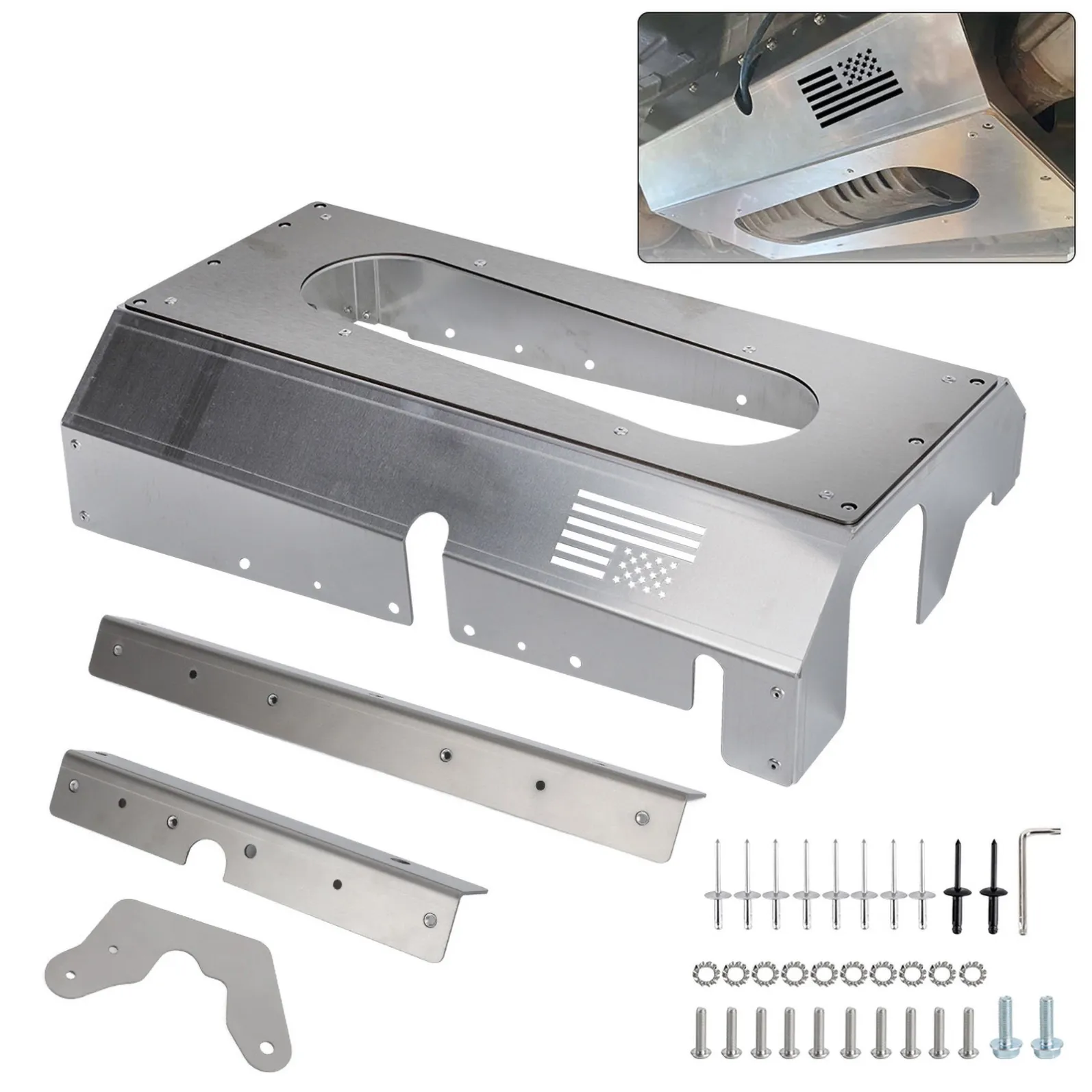
The buyer should understand what the shield actually covers. Some designs are single-piece panels. Others may use multiple panels, brackets or separate hardware. A useful product record should show the shield layout clearly enough for a buyer to understand the basic configuration.
Ask for:
- Main shield panel images
- Component images
- Hardware images
- Underbody placement images if available
- A package contents list
Do not assume that every photo shows a complete orderable kit. A photo may show a prototype, a partial set, a display arrangement or a supplier sample. For B2B sourcing, the product record should separate what is visible in the image from what is confirmed in the package.
3. Confirm Material, Thickness and Finish
Material matters, but it should be documented rather than guessed. If a supplier confirms only a general material type, use that general description. If the exact alloy or thickness is not documented, leave it blank or mark it for review.
For a shield buying file, request:
- Material type
- Exact material grade if available
- Material thickness
- Surface finish
- Corrosion-related test information if any
- Supplier drawing or specification sheet
Avoid marketing language that overstates the material. Without supplier evidence, do not describe a shield as impossible to defeat, fully corrosion resistant or able to provide the highest possible level of protection. A more supportable description is that the shield adds a physical barrier around the catalytic converter area.
4. Review Ventilation and Service Access
Because the shield sits near the exhaust area, buyers should look at ventilation openings and service access. The goal is to understand how the design allows airflow around the exhaust area and whether routine inspection or service will be affected.
Questions to ask:
- Are ventilation openings visible in the shield design?
- Does the supplier provide any installation guidance?
- Can the shop inspect the converter area after installation?
- Does the shield interfere with nearby service points?
- Are there maintenance notes for removal and reinstallation?
This is also where regional requirements can matter. California's Bureau of Automotive Repair notes that theft-prevention devices should not modify or damage the catalytic converter and should not hide required identifying information. That is a California-specific compliance context, not a universal legal rule. For all buyers, the useful decision is to check installation details and destination-market requirements before ordering or fitting the part.
5. Verify Mounting Method and Hardware
Installation claims should be handled carefully. If the mounting method is not verified, use restrained wording such as "application-specific mounting configuration" and ask the supplier for details.
Before buying, confirm:
- Mounting points
- Hardware included
- Whether brackets are included
- Tooling or shop equipment needed
- Whether drilling, welding or modification is required
- Whether installation instructions are available
Do not claim no-drill, direct bolt-on or no-welding installation unless supplier documentation supports it. For distributors, the risk is not only technical. Unsupported installation promises can create avoidable customer service problems after the sale.
6. Look for Product Images That Support the Listing
Images are evidence, but only up to a point. A clear main image can help confirm the general product type. It cannot confirm alloy grade, thickness, complete hardware contents or compatibility with every vehicle configuration.
Good product image sets usually include:
- One clean main image of the shield
- Component or panel images
- Hardware image if hardware is included
- Detail images showing ventilation and mounting areas
Avoid using a bundle image as the main image for an individual shield product. If a photo shows both a catalytic converter and a shield, it may be useful for comparison or buyer education, but it should not automatically become the main image for a shield-only listing.
7. Confirm What the Product Is Supposed to Do
A catalytic converter shield is a theft-deterrent measure. Its purpose is to add a physical barrier around the catalytic converter area and help make direct access more difficult. It is not a promise that theft cannot happen.
This distinction matters in product copy, distributor catalogs and customer conversations. Public sources commonly recommend combining deterrent steps: strategic parking, security cameras, vehicle or converter marking and anti-theft devices. A shield can be part of that layered approach, but it should be described realistically.
Useful wording:
- Vehicle-specific catalytic converter anti-theft shield
- Adds a physical barrier around the catalytic converter area
- Helps make direct access more difficult
- Application-specific mounting configuration
- Contact us to confirm fitment and installation requirements
Avoid wording that suggests certainty or exaggerated protection.
8. Check Product Page Quality Before Adding It to a Catalog
For B2B buyers, a shield listing should be clear enough for sales teams, customer service and downstream buyers to use. If the product record is vague, the missing information should be collected before broad promotion.
A strong shield product page should include:
- Product name
- Vehicle year range
- Vehicle make and model
- Short description
- Main image and gallery images
- Package contents
- Material information if confirmed
- Installation notes
- CTA for fitment confirmation
- Missing data marked clearly
For a distributor or private-label buyer, add three commercial fields to the internal sourcing record:
- Applications currently supported and applications still requiring confirmation
- Expected trial quantity, repeat quantity and destination market
- Evidence required before the product can be listed, quoted broadly or included in a private-label assortment
Final Checklist for a distributor or repair-shop RFQ
Before buying or listing a catalytic converter shield, confirm:
- The exact vehicle year, make and model
- The relevant converter location
- The shield configuration and package contents
- Material and thickness documentation
- Mounting method and hardware
- Ventilation design
- Installation requirements
- Product images and image rights
- Any regional installation or inspection considerations
- Whether the supplier can support OEM/ODM, packaging or B2B ordering needs
Send the request in this order: application first, product configuration second, commercial requirements third. If a field is unavailable, label it as missing and ask the supplier what evidence can replace it. Do not use a similar vehicle listing or a marketplace photo as a substitute for application confirmation.
If any of these details are not available, mark them for review instead of filling the gap with assumptions.
CTA: send the information needed for a sourcing review
For a distributor or wholesaler, send the target applications, model-year ranges, expected quantities, current return or fitment problems and destination market. For a repair or exhaust shop, send the vehicle year, make, model, available application or part evidence, quantity, timing and any replacement-plus-protection requirement. For a private-label buyer, add annual volume, packaging and branding requirements.
MetalPro can then review what information is available before quotation and identify which application, configuration or documentation questions still require confirmation. A shield should not be quoted as a guaranteed theft-prevention result or as a universal fit without evidence.
FAQ
Can a distributor stock one catalytic converter shield for several vehicle applications?
Do not assume that. Separate the applications in the sourcing record and confirm the vehicle-specific configuration before treating a product as one stock-keeping unit or a multi-application listing.
What should a repair shop send when asking for a shield quote?
Send the vehicle year, make, model, available application or part evidence, quantity, destination, required timing and whether a replacement converter is being evaluated separately. Ask the supplier to identify missing information before quotation.
Does a shield guarantee that a catalytic converter cannot be stolen?
No. A shield can add a physical barrier and may make direct access more difficult, but no guarantee of theft prevention should be made without authoritative product-specific evidence.